Our Programs

Franco-Thai Scholarship Program

Supporting Thai students under 35 who intend to study at French universities and higher-education institutions for a Master's degree or a PhD.
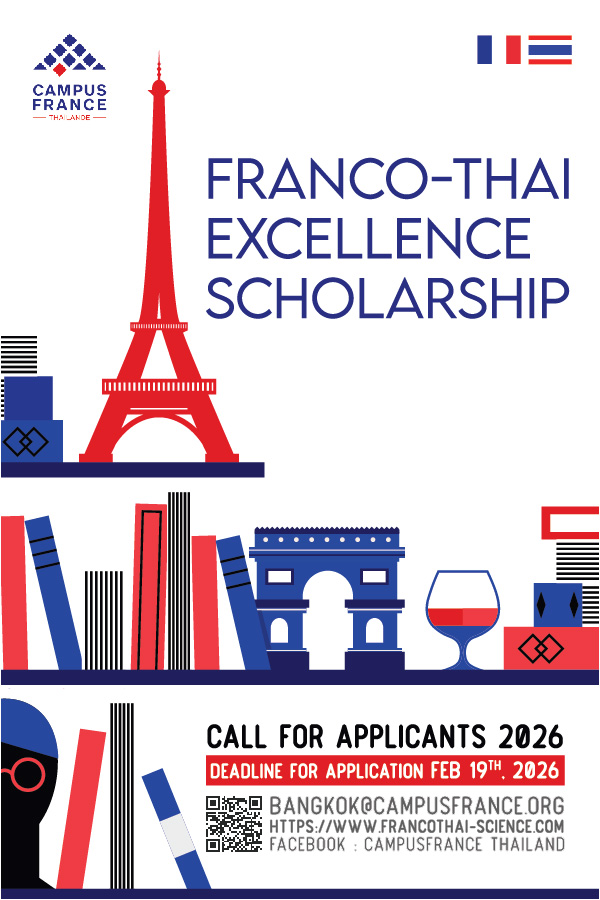
Poster for Franco-Thai Excellence Scholarship with Eiffel Tower, Arc de Triomphe, books, and application details.

The Franco–Thai Scholarship Program of the Embassy of France in Thailand aims to support Thai students under 35 who intend to study at universities or higher-education institutions in France for their Master's degree or PhD. Open to all fields of study, this program is a highly selective call for candidates to strengthen high-level exchanges between France and Thailand.

The Franco-Thai scholarship is granted for the period necessary to obtain the degree: one or two years for a Master's Degree and three years for a PhD.

In case of co-supervision, the scholarship will only be granted for the periods spent in France.

If the curriculum requires some coursework that takes place outside France, the scholarship will be suspended during that period.

The Franco-Thai scholarship program offers two types of scholarships:

Full Scholarship

The full scholarship benefits include:

A monthly allowance
A round-trip ticket
Social protection
French government grant-holder advantages

Social Protection Scholarship — Bourse de Couverture Sociale

The “Bourse de Couverture Sociale” gives access to a specific status, enabling candidates to benefit from social protection in France and other advantages (exemption from visa fees, CVEC fees, and tuition fees for some public higher-education programs).

!

This scholarship can only be granted if a cost-sharing agreement ensures a monthly allowance for the scholar, since the allowance is not provided by the Franco-Thai program for this scholarship type.

Cost-sharing

Both Master and PhD applicants are highly encouraged to look for other sources of funding — not only from their own local or foreign university but also from the private sector. Special attention is given to academic applicants who have secured other sources of funding for their project.

Some doctoral schools ask for a higher monthly income than the allowance granted by this program. Students applying to those schools must check and coordinate with the French laboratory or doctoral school to secure additional funding.

Tuition Fees

For some Master's programs taught in French at a public university and for PhD programs, being a French Government scholar means tuition fees will be lifted. It is the candidate's responsibility to check the tuition fees for the program they are applying to.

i

Please note that the Franco-Thai Scholarship Program does not cover tuition fees.

Selection Criteria

In order to identify grant recipients, the selection committee will consider:

In Partnership with
Logo with colored squares M H E S I and text Ministry of Higher Education, Science, Research and Innovation.
Some Numbers
200
Candidates each year
20
PhD students per year
2500
Alumni in total
480
Scholarship holders

Frequently Asked Questions

Everything you need to know about the Franco-Thai Scholarship.

Can I apply for a scholarship from a Franco-Thai program if I am enrolling in a program taught in English?+
Yes, if you enrol in a program offered by any French Higher Education Institution and if your application meets eligibility criteria.
Is there any set quota on the number of scholarships granted?+
No, there is no specific quota. For the 2025 program, around 10 new scholarships were granted.
Is there any set distribution of scholarships by field of studies?+
No, only the best applications are selected, regardless of the field of studies. All fields of studies are encouraged. Every application and project will benefit from a specific attention.
How can I find Master programs or advisors in France?+
The database of Campus France provides a large number of programs and PhD thesis topics through the Campus France Thailand website. The Campus France team can also help you figure out which programs might be more coherent with your study and career plans.
Under the scholarship program, is it possible to apply for more than one university in France?+
Yes, on condition that their curriculum is the same. For example, when the applicant of the Franco-Thai Scholarship Program uses the proof of contact with University A and B for a Master program in Education, it is necessary to explain the similarity of their program and identify his/her first choice of University in the motivation letter.
May I apply for the Franco-Thai scholarship program even if I am not a graduate yet?+
Yes, but only if you are currently in your last year of Bachelor at university for a Master scholarship, or in your last year of Master level for a PhD scholarship. You will just need to enclose the attestation of your current enrolment in your university; and if possible your latest semester academic records.
Among the criteria mentioned, which are the most decisive in the awarding of the scholarship?+
Every criterion (excellence of the candidate, quality of the study plan, motivation of the candidate, level of proficiency in foreign languages) is decisive.
What is included in a full scholarship?+
A full scholarship includes a monthly allowance, a round-trip ticket, social protection, and the advantages granted to French government scholarship holders.
What is the difference between a Bourse de Couverture Sociale and a Full Scholarship?+
A Full Scholarship pays the monthly allowance directly. The Bourse de Couverture Sociale provides social-protection status and exemptions, but the allowance must come from a cost-sharing agreement.
What is the amount of the monthly allowance provided?+
The maximum allowance granted is 860 Euros per month for Master's degree and 1,770 euros per month for PhD.
Does the Franco-Thai Scholarship Program cover tuition fees?+
No. The program does not cover tuition fees, although fees may be lifted at some public universities for French government scholars.
What is a cost-sharing agreement?+
A scholarship can be co-financed by a private company or a foreign or local institution for both Master's degree and PhD. Different patterns of cost-sharing can be put into place depending on the nature of the relationship between the student and the co-funding institution. Local and foreign universities can participate in this scheme in funding fully or partly the monthly allowance.
My doctoral school asks for 1,800 EUR/month but my institution gives only 1,200 EUR/month. Can I ask for additional funding?+
Yes, it is possible to ask for additional funding from our Program. You can indicate this request in your application.
My doctoral school asks for 2,000 EUR/month but the maximum allowance is 1,770 EUR/month. What should I do?+
Since 2011, some doctoral schools ask for a minimum income for PhD students to enrol in their programs. This required income may be higher than the maximum grant of our program. Thus, you should discuss with your future advisor in order to look for other sources of funding. It is highly recommended for PhD students to look for a co-funding scheme. However, this co-funding scheme cannot combine with a work contract with French companies or institutions.
How can I find the co-funding institutions?+
You can ask your future advisor to help you find the funding. You can also look for other sources of funding from the private sector. Some universities and doctoral schools in France can provide research funding for PhD projects. It is necessary to provide a proof of co-funding. All kinds of cost-sharing scheme are welcome.
If I receive financial support from my employer, can I still apply for additional funding?+
Yes, it is possible to apply for this scholarship. The cost-sharing scheme can be discussed later.
Which level of language proficiency is required to obtain a scholarship?+
The level of proficiency required should be consistent with the program to be followed.
May I apply if the enrolment or selection process in France is not completed yet?+
Yes. If the enrolment attestation cannot be provided for the submission of the application to the scholarship program, the applicant can include proofs of contact such as mails or e-mails between the university in France and the candidate instead.
May I apply when the university requires the graduate degree before the enrolment procedure?+
If an enrolment attestation cannot be provided for the submission, the application file must include e-mail exchange between the host university in France and the candidate. The university in France could also send an enrolment attestation conditional to the success of the candidate in his/her examinations.
Should I apply to the first or the second year of the Master's Degree?+
Due to the difference between the French and Thai academic frame regarding the length of the Bachelor Degree, Thai students who got their Bachelor degree in Thailand can apply directly to the second year of a Master Degree in France (M2). Admission to the second year of a Master Degree is under the authority of the selected Higher Education institution. In some cases, an admission to the first year of the Master Degree may be more appropriate due to various reasons: global level of the training, content of the classes to be attended, specialities of the program etc.
What form should the presentation of the personal project take?+
The presentation of the personal project should supply the selection committee with key elements in order to help assess the candidate's choices in terms of university, curriculum, and research subject with regards to his/her previous studies. Besides, this presentation should clearly highlight the candidate's motivation. There are no specific requirements regarding the format of this presentation.
Apply here